
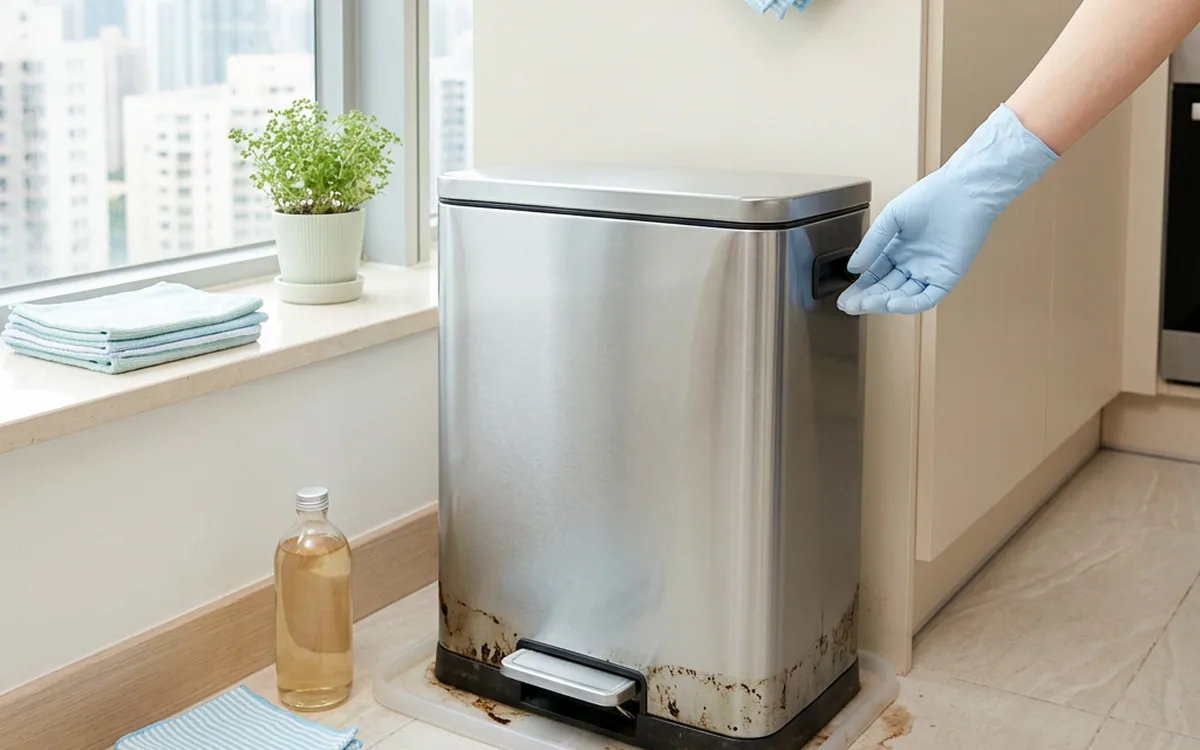
The leakage from the bottom of the trash can contains grease and acidic substances, which easily penetrate into building material joints. 壹家壹清潔專家 suggests never using strong acids or alkalis, but instead choosing suitable active enzymes to break down the dirt, then removing it physically, and keeping the bottom dry.
Physical Penetration and Stain Formation
Liquid food waste accumulated at the bottom of the trash can contains grease, protein, and acidic substances, which are highly sticky and corrosive. Microscopic pores in tile grout or wood surfaces create a capillary suction phenomenon, absorbing the liquid into the building material. After water evaporates, the residue and the surface form hardened, blackened, aged stains that cannot be removed by ordinary wiping.
Bacterial Biofilms and Health Risks
The surface of aged stains easily forms biofilms, which serve as breeding grounds for microorganisms. In humid environments, these bacteria and molds continuously emit odors and attract insects, potentially affecting indoor air hygiene and family health.
Systematic Stain Removal and Material Assessment
Treating aged stains requires targeted solutions based on the material to ensure the floor coating is not damaged. Strictly forbid mixing chemical agents arbitrarily to avoid danger or corrosion of building materials.
When handling moldy materials, you can follow US Environmental Protection Agency's home mold prevention recommendations(opens in a new window)treatment and note the on-site and material restrictions.
- Material assessment: First test in an inconspicuous area whether the cleaning agent causes discoloration.
- Chemical emulsification: Select an active enzyme decomposing agent corresponding to the material to emulsify grease and proteins.
- Physical kinetic energy: Use low-pressure physical jet equipment to precisely remove deep dirt.
- Complete drying: Ensure the area is ventilated and dry after completion to prevent mold growth.
Why Seek a Professional Team
Cleaning dead corners involves complex biological treatment and the use of precision instruments; incorrect DIY can lead to permanent floor damage. Professional cleaning teams can use suitable equipment to clean aged stains according to the object's material properties, avoiding surface damage.
