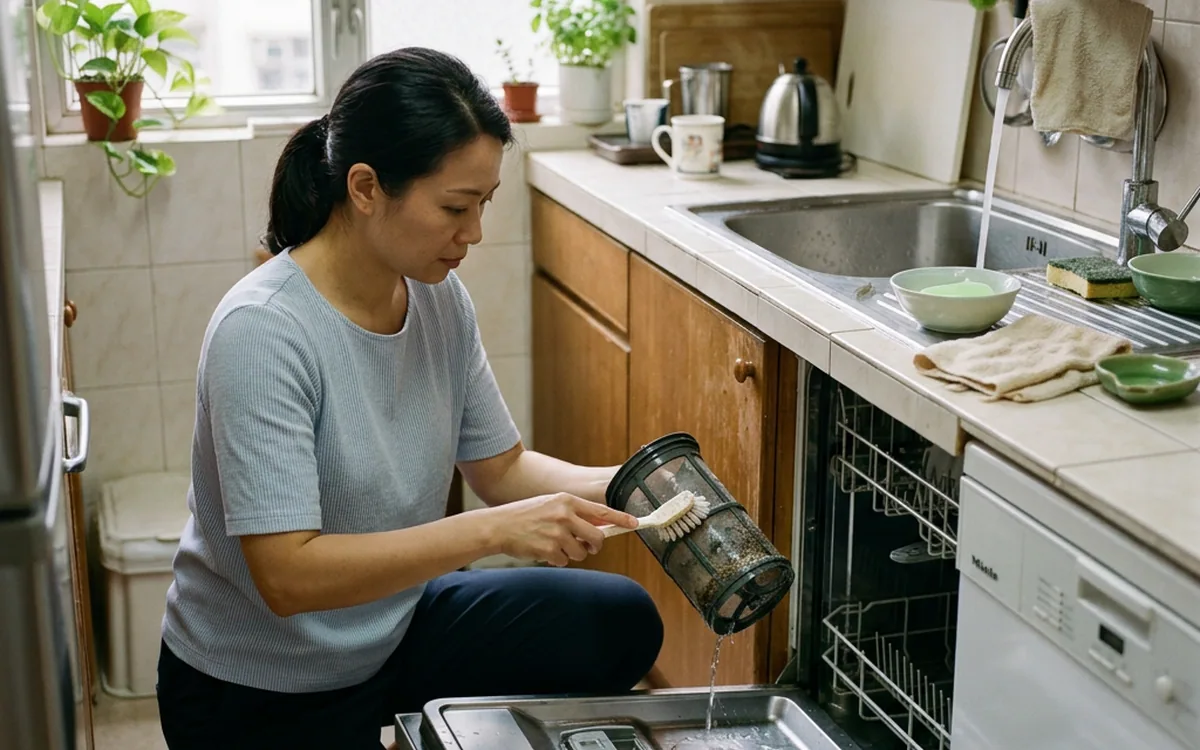
Cleaning the dishwasher should first involve cleaning the residue filter and spray arm holes, and use special machine detergent according to manufacturer recommendations. Never use hand-dishwashing soap as a substitute, and strictly forbid mixing bleach or other strong acid/alkali cleaners. If drainage faults or error codes appear, stop operation and assess repair needs.
What to check first if it's not cleaning well?
Tableware blocking each other, spray arm unable to rotate, filter full of residue, and unsuitable detergent may all affect results. Look at instructions and actual usage first, do not treat all problems as serious internal dirtiness.
If there are leaks, inability to drain, or fault codes, record the situation and arrange for inspection, do not repeatedly force operation.
How to maintain filter and spray arms?
Wait for the machine to cool down before removing designated parts according to manufacturer's method. Watch out for sharp objects like glass fragments, do not reach into unseen depths by hand.
- Empty tableware and turn off machine according to requirements
- Remove removable filter according to instructions
- Remove residue and wash using suitable method
- Check reachable spray arm holes
- Install back to correct position and check
Which products should not be used arbitrarily?
Machine-use cleaning agents, descalers, detergents, and rinse aids each have their own purposes. Ordinary hand dishwashing liquid may generate excessive foam and should not be used as a substitute.
| Item | To be verified |
|---|---|
| Detergent | Applicable machine-use products and dosage |
| Descaler | Manufacturer approval and procedural requirements |
| Filter cleaning | Component materials and cleaning methods |
| Mixing products | Do not mix different ingredients yourself |
What to ask for built-in deep cleaning?
Check the machine model, door panel, surrounding cabinets, and utility locations, and ask if pulling out the unit is required. Cleaning the interior cavity is not equivalent to dismantling water pumps, pipes, or all internal layers.
Existing door seals, rust, or leaks should be recorded beforehand; parts that cannot be safely dismantled should be clarified separately.
What to observe after cleaning?
Check if parts are correctly reinstalled, tableware is placed properly, and the applicable program is selected, then observe if residues or odors persist. Ongoing issues may be related to water, detergent, or malfunctions.
Use according to manufacturer requirements; do not judge the overall situation based solely on scent, foam levels, or a single result.